In short
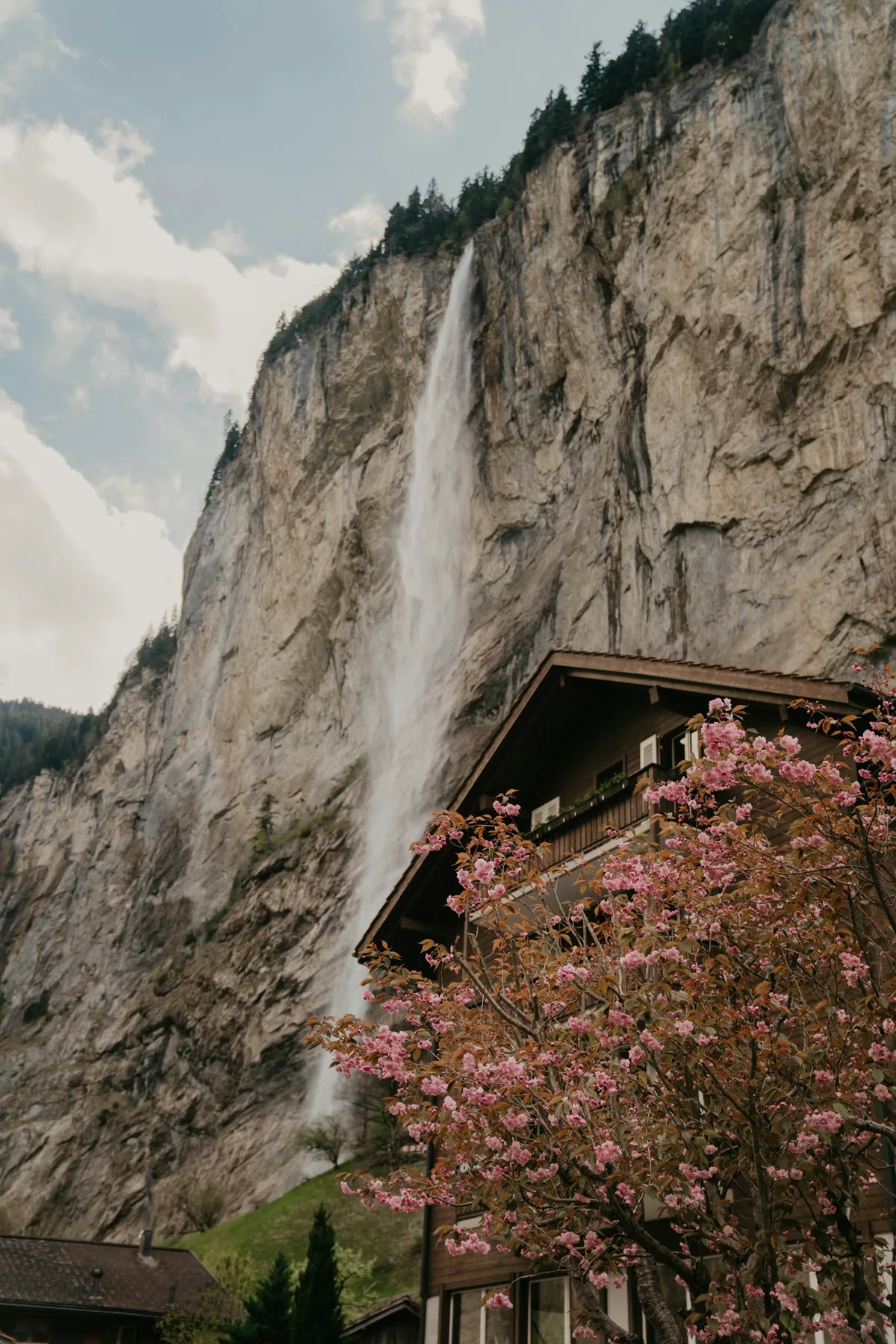
Lauterbrunnen is a valley floor barely a few hundred metres wide with rock walls on both sides and the Staubbach Falls dropping 297 metres off the western cliff — the highest free-falling waterfall in Switzerland. It is 22 minutes by train from Interlaken Ost with no change. Everything below carries the fare in Swiss francs as the operator states it, the travel time from Lauterbrunnen station, and where something does not justify what it costs, that is written down too.
Quick Facts
- Elevation
- 795 m
- Getting There
- 22 min by train from Interlaken Ost, no change Journey time checked
- Duration
- Half day to two days
- Price
- The valley itself is free
- Season
- Waterfalls at their fullest May–July
- Best for
- Families, hikers, photographers
Chapter 01
The valley at a glance
Five things worth doing, side by side. One of them is free, one is the single best paid thing here, and one costs very nearly as much as the discounted entry fare to the Jungfraujoch.
| Destination | From Lauterbrunnen station | Price What is a pass day?One pass day is CHF 80 — the Berner Oberland Pass for 3 days (CHF 240), divided by 3. One-way fares are counted as return trips for this comparison. What else costs what here | Time needed | Season | With kids |
|---|---|---|---|---|---|
| Staubbach Falls | 10 min On foot | Free | 45 min | Year-round | Yes |
| Trümmelbach Falls | 7 min Bus | CHF 18 Admission · up to ¼ pass day | 1–1.5 hrs | April–November | Yes |
| Wengen (car-free village) | 11 min Train | Not verified | Half day | Year-round | Yes |
| Mürren via Grütschalp | 21 min Cable car | Not verified | Half day | Year-round | Yes |
| Schilthorn — Piz Gloria | 40 min Cable car | CHF 115 return · over 1 pass day | Full day | Year-round | Yes |
Travel times: fastest public connection from Lauterbrunnen station to the destination itself — for mountain destinations that means the top station, not the valley station. Places in the village are walking times. From Interlaken Ost, add the 22 minutes down the valley.
Adult prices, as of the date at the foot of this page. Cableway and boat fares vary by route, travelcard and guest card.
One pass day is CHF 80 — the Berner Oberland Pass for 3 days (CHF 240), divided by 3. One-way fares are counted as return trips for this comparison. What else costs what here
Two fares are marked as unverified on purpose. Neither Jungfraubahnen nor the local operator publishes a plain single fare for Lauterbrunnen – Wengen or Lauterbrunnen – Mürren in a form we could quote with confidence, and inventing a plausible figure would destroy the one thing this table has that the competing guides do not.
Chapter 02
Where everything is
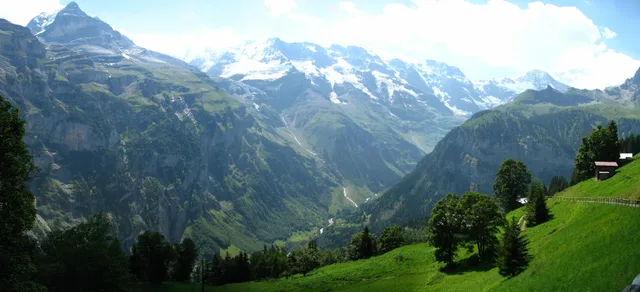
The valley runs almost straight from north to south, and that is the whole geography of a day here: the two waterfalls are on the floor, the three car-free villages are on the terraces to the east and west, and the Schilthorn is behind Mürren.
Where is what?
Orientation map: relative positions to scale from coordinates, without terrain.
- Altitude 795 m
- Getting there 0 min On foot
- Price Free
- Time needed Base of the day
- Season Year-round
- Getting there 10 min On foot
- Price Free
- Time needed 45 min
- Season Year-round
- Altitude 818 m
- Getting there 7 min Bus
- Price CHF 18 (Admission)
- Time needed 1–1.5 hrs
- Season April–November
- Altitude 882 m
- Getting there 12 min Bus
- Price Free
- Time needed Valley walk finishes here
- Season Year-round
- Altitude 1,482 m
- Getting there 7 min Cable car
- Price Not verified
- Time needed Change for Mürren
- Season Year-round
- Altitude 1,274 m
- Getting there 11 min Train
- Price Not verified
- Time needed Half day
- Season Year-round
- Altitude 1,649 m
- Getting there 21 min Cable car
- Price Not verified
- Time needed Half day
- Season Year-round
- Altitude 1,367 m
- Getting there 31 min Cable car
- Price Not verified
- Time needed Half day
- Season Year-round
- Altitude 2,970 m
- Getting there 40 min Cable car
- Price from CHF 115
- Time needed Full day
- Season Year-round
© OpenStreetMap contributors · © swisstopo (swissNAMES3D)
Travel times from Lauterbrunnen station, fastest connection on a summer weekday. Coordinates for Grütschalp, Stechelberg, the Trümmelbach stop and the Staubbach come from the federal swisstopo gazetteer, checked 17 August 2026; the rest come from our own destination data. The Staubbach carries no altitude here on purpose — the registered point sits at the lip of the fall at 1,126 m, not at its foot, and a figure on a map pin reads as the height of the place.
Chapter 03
The two waterfalls
Staubbach Falls — free, and ten minutes from the station
The Staubbach drops 297 metres in a single free fall from the cliff above the village, which makes it the highest free-falling waterfall in the country. It is visible from the station platform, and the walk to its foot takes about ten minutes along the valley road.
A gallery hewn into the rock leads up behind the curtain of water. It is seasonal — closed through winter and in poor conditions — so check before you plan the day around it. The fall carries by far the most water from May to July, when the snowmelt is running; by late summer it can thin to a drifting veil, which is where its name comes from. That is worth knowing before travelling in September expecting the postcard.
Trümmelbach Falls — the one paid thing to do
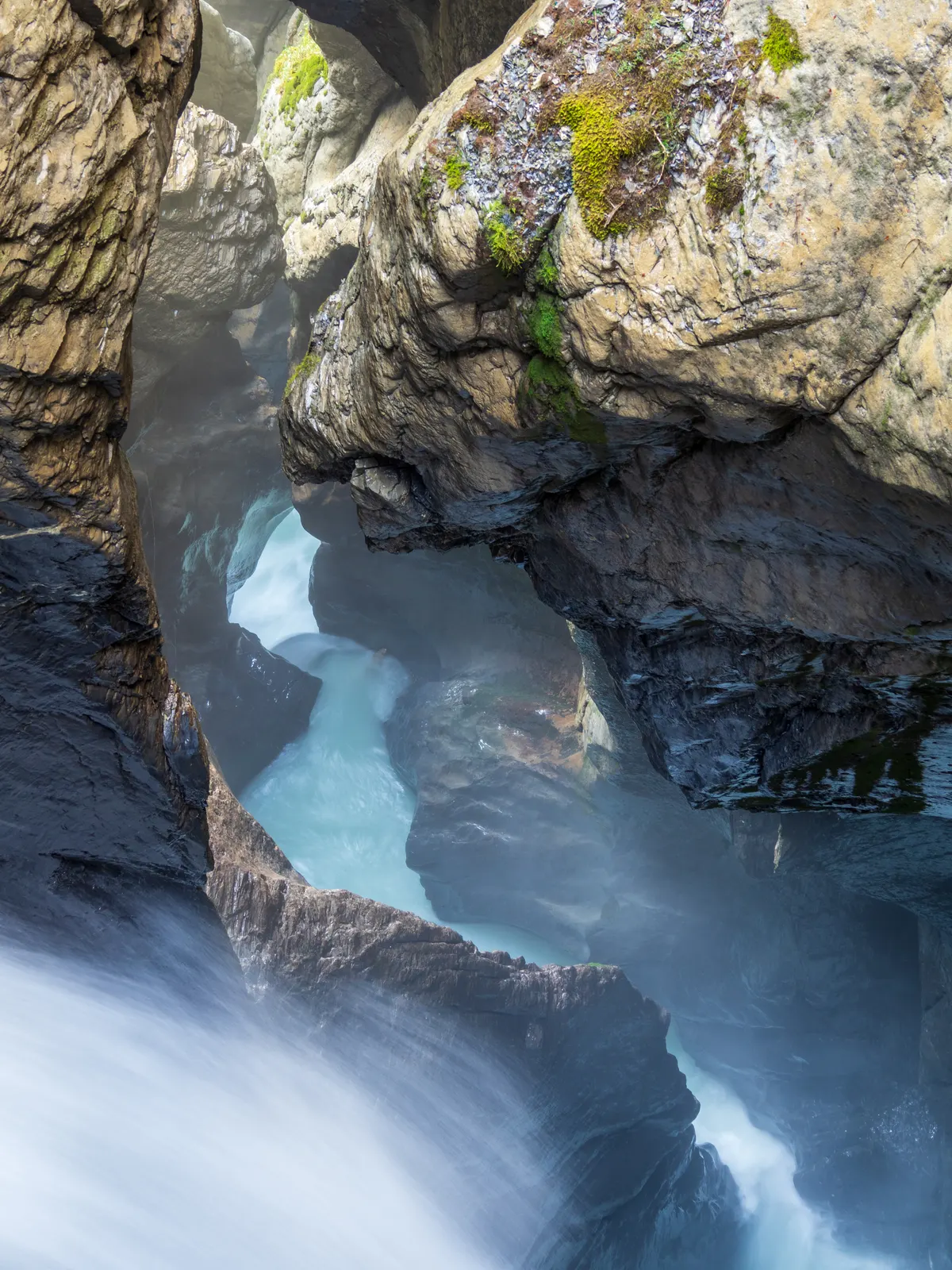
If you do one thing here that costs money, make it this. The Trümmelbach is not a waterfall you look at from outside: ten glacier waterfalls run inside the mountain, and a tunnel lift built into the rock takes you up to walkways alongside them. The operator states the stream drains the glacier faces of the Eiger, Mönch and Jungfrau — a catchment of 24 km², up to half of it under snow and ice — at up to 20,000 litres a second.
- Admission: CHF 18 adults, CHF 8 children aged 6–15. No group rates. Checked with the operator on 14 October 2026.
- Season and hours: early April to early November, daily 9:00–17:00; in July and August 8:30–18:00.
- Getting there: Postbus from Lauterbrunnen station to the "Trümmelbachfälle" stop, 7 minutes. By car it is about 3 km beyond the village.
- On foot: you can walk it, and most guides forget to say so. A level, signposted path runs along the valley floor from Lauterbrunnen towards Stechelberg and passes the falls — Lauterbrunnen Tourism describes it as a mostly flat hike. Station to the Trümmelbachfälle stop is 2.96 km in a straight line (federal swisstopo coordinates, measured 5 August 2026); the path follows the valley, so the walked distance is a little more. No official signposted walking time is published — not by the operator, not by the tourist office — so we do not quote one.
- Not admitted: babies and children under 4, and dogs — the operator excludes them for safety reasons. Worth knowing before you travel out with a pushchair.
Allow an hour to an hour and a half. It is cold and wet inside whatever the weather outside is doing, which also makes it the obvious choice on a rainy day.
Chapter 04
The villages above the valley
The valley floor is a short visit. What turns Lauterbrunnen into a full day is what sits on the terraces above it — and both of those villages are genuinely car-free, unlike Lauterbrunnen itself.
- Wengen — 11 minutes by cog railway, at 1,274 m, facing the Jungfrau and the starting point for the Männlichen cable car. What car-free means in practice, and the fare nobody publishes, is on its own page.
- Mürren — 21 minutes, first the cable car to Grütschalp, then the panorama railway along the terrace. Smaller, higher, quieter, and the ride itself is half the reason to go.
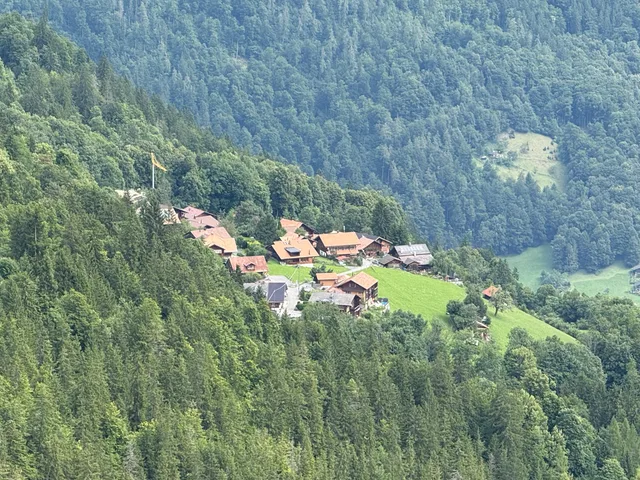
- Gimmelwald — below Mürren, reachable by cable car. A hamlet rather than a resort, which is precisely its appeal.
Insider Tip
Take the Grütschalp cable car up and the train along to Mürren, then walk back down to Lauterbrunnen instead of riding. The path drops through the terrace forest with the valley opening below you the whole way — and it costs nothing beyond the single ride up. The rides are frequent enough that you can decide at the top, depending on how your legs feel.
Chapter 05
Schilthorn — is Piz Gloria worth it?
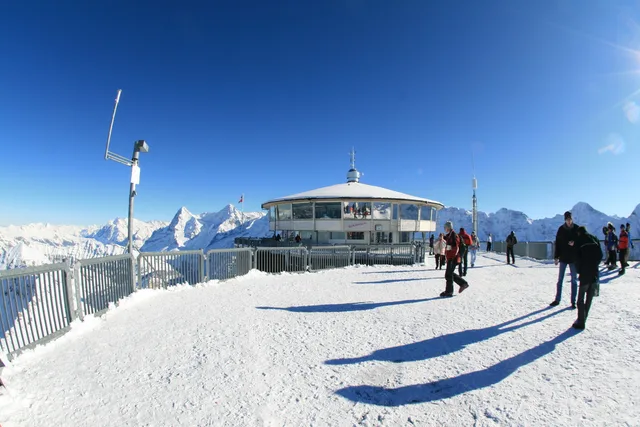
The 2,970-metre summit with the revolving restaurant of On Her Majesty's Secret Service is the expensive option in this valley: CHF 115 return from Lauterbrunnen via Grütschalp — very nearly the discounted Jungfraujoch fare, for a lower summit. It is worth it if the restaurant and the 360° panorama are the point of your day — and it is not, if you mainly want height and a view, because Birg one stage below already delivers most of it.
Schilthorn and Piz Gloria: every fare, and when it is not worth it
Chapter 06
Valley floor or terrace: where to base yourself
The question behind “where to stay in Lauterbrunnen” is not which hotel — it is whether to sleep on the valley floor or a thousand feet above it. Five places are realistic, and four facts decide between them.
| Base | Altitude | From the station | Cars | In winter |
|---|---|---|---|---|
| Lauterbrunnen Shortest travel each day, cheapest to reach, and the noisiest | 795 m | — | Road, station car park | All year, but the valley sights close |
| Wengen Sun terrace facing the Jungfrau, and the easiest of the three to reach | 1,274 m | 11 min | Car-free | Ski village, full winter service |
| Mürren Highest and quietest of the three, and the gateway to the Schilthorn | 1,649 m | 21 min | Car-free | Ski village, full winter service |
| Gimmelwald A hamlet, not a resort — the point is that nothing happens there | 1,367 m | 31 min | Car-free | Barely any infrastructure |
| Stechelberg Valley station of the Schilthorn cable car, and the quiet end of the road | 882 m | 12 min | Road, end of the valley | Cable car runs, little else |
Travel times measured on 17 August 2026 in the Swiss timetable for a Wednesday in August 2026 from 09:00, fastest of six connections. Wengen and Mürren reproduce the figures in the table further up exactly, which was the point of re-measuring them. Altitudes from our destination data; Stechelberg from the swisstopo elevation service.
The trade is the same in every direction: height against the last departure. Sleeping up in Wengen or Mürren buys the view and the quiet, and costs a cable-car ride at each end of every day — including the evening you misjudge. Sleeping in the valley costs nothing extra and puts you on the train first thing, in a village that a few thousand day visitors pass through. Gimmelwald is the outlier: half an hour and a change away from a station, with nothing in it, which is exactly why people who have been go back.
Chapter 07
One day, and two
The competing guides list twenty-three things to do and leave the ordering to you. Here is the ordering, with the constraint that actually binds: the Trümmelbach is a bus ride away and needs an hour and a half, and the terrace villages need a cable car.
One day, from Interlaken Ost
- Morning — train to Lauterbrunnen (22 min, no change), then straight up: Grütschalp cable car and the panorama railway to Mürren. The valley fills with coaches by mid-morning and the terrace does not.
- Midday — Mürren, and back down on foot to Lauterbrunnen if the legs allow, otherwise the same way.
- Afternoon — Postbus to the Trümmelbach Falls (7 min), an hour inside the mountain, bus back.
- Late afternoon — the ten-minute walk to the foot of the Staubbach, then the train home.
What this leaves out is the Schilthorn. It does not fit: CHF 115 and most of a day. Choose it instead of the afternoon, not after it.
Two days, staying in the valley
- Day one — the valley floor at its own pace: Staubbach, the walk along the Weisse Lütschine to Stechelberg (7.3 km, level, bus back), Trümmelbach on the way. A day without a single cable car.
- Day two — the terraces: up to Grütschalp, along to Mürren, and either the Schilthorn from there or the walk down through Gimmelwald.
Two days is the point at which staying here beats a day trip, and the reason is the evening: the valley empties around six, and the walls turn the colour that every photograph of this place is trying for.
Chapter 08
If you only have two hours
A very common case — Lauterbrunnen is often a stop between trains rather than a destination. Two hours is enough for the free half of the valley and nothing more:
- Walk up the valley road to the foot of the Staubbach Falls (10 minutes each way).
- Climb the gallery behind the fall, if the season allows.
- Return along the Weisse Lütschine through the village.
What does not fit in two hours: the Trümmelbach Falls, which need the bus each way plus an hour inside, and anything above the valley. Trying to add either is how people end up running for a train.
Chapter 09
What costs nothing
More than in most of this region. The Staubbach Falls and the path to their foot, the valley-floor walk, the village, and — through the summer — the base jumpers. The cliffs here are among the busiest jumping sites in the world, and on a fine day you can watch canopies opening against the rock wall from a bench on the valley floor without paying anything or booking anything.
Chapter 10
When to come
- May to July — the waterfalls carry the most water. This is the valley at its best and also its busiest.
- September and October — quieter and clear, but the Staubbach can be thin. The Trümmelbach runs to early November.
- Winter — the Trümmelbach is closed, the Staubbach gallery too. Wengen and Mürren carry the season instead, as ski villages.
Whatever the month, go early. The valley is full of coaches from Interlaken by mid-morning, and the road to the Staubbach is narrow.
Chapter 11
About those "72 waterfalls"
The figure appears in nearly every article about this valley, including ours. It is the region's own count and it includes a great many thin seasonal streams off the walls. Named ones are far fewer — Staubbach, Trümmelbach, Mürrenbach, Buchenbach, Mattenbach — and precisely two are set up to be visited. Worth knowing before you arrive expecting seventy-two of anything.
Related Articles
Back to overview: All things to do in Interlaken
Frequently Asked Questions
Is Lauterbrunnen worth visiting?
Yes, and it needs less time than most guides suggest. The valley floor with the Staubbach Falls is a genuine sight and reachable in 22 minutes from Interlaken Ost without changing trains. What it is not is a full-day destination in itself: the village has one main street. The day gets filled by what sits above it — Wengen, Mürren, the Schilthorn — or by a hike.
How do you spend 2 hours in Lauterbrunnen?
Walk from the station up the valley to the foot of the Staubbach Falls — about ten minutes each way — climb the gallery behind the fall if it is open, and walk back along the Weisse Lütschine. That is the whole of the free valley-floor circuit and it fits in two hours with time for a coffee. The Trümmelbach Falls do not fit: the bus, the tunnel lift and the walkways need an hour and a half on their own.
What should you not miss in Lauterbrunnen?
The Trümmelbach Falls, if you only do one paid thing. Ten glacier waterfalls run inside the mountain, carrying up to 20,000 litres a second from the Eiger, Mönch and Jungfrau, and a tunnel lift takes you into the rock to see them. CHF 18 for adults, CHF 8 for children aged 6 to 15 — checked with the operator on 14 October 2026.
How long is the walk to Trümmelbach Falls?
Longer than the bus and shorter than most people expect. The falls sit 2.96 km from Lauterbrunnen station in a straight line — measured from the federal swisstopo coordinates of the two bus stops on 5 August 2026 — along a level, signposted valley-floor path towards Stechelberg. Honest answer on the time: nobody publishes an official signposted figure for it, so we do not invent one. The Postbus covers the same distance in 7 minutes, and that is the number you can rely on.
Which is better, Grindelwald or Lauterbrunnen?
Grindelwald is the bigger place with more hotels, more shops and direct access to First and the Eiger Express. Lauterbrunnen is smaller, quieter and more dramatic — the valley walls are what people come for. For a base of several nights with varied excursions, Grindelwald. For the scenery itself and for reaching Wengen, Mürren and the Schilthorn, Lauterbrunnen. Both are around 22 to 36 minutes from Interlaken Ost.
Is Lauterbrunnen car-free?
No — this is a common mix-up. Lauterbrunnen village has a road, parking and a large car park at the station. The car-free villages are Wengen and Mürren above the valley, which is exactly why people park in Lauterbrunnen and take the train or cable car up.
Is the Schilthorn worth CHF 115?
That is the return fare from Lauterbrunnen via Grütschalp, checked with Schilthornbahn on 14 October 2026, and it is real money — very nearly the discounted entry fare to the Jungfraujoch, for a lower summit. It is worth it if the revolving restaurant and the 360° panorama are the point of your day. If you mainly want height and a view, Mürren and Birg cost a fraction. A Swiss Travel Pass brings it to CHF 45.70; the Berner Oberland Pass covers it entirely.
What can you do in Lauterbrunnen for free?
The Staubbach Falls and the path to their foot, the valley-floor walk along the Weisse Lütschine, the village itself, and watching the base jumpers who use the cliffs through the summer. That is a comfortable half day without a ticket of any kind.