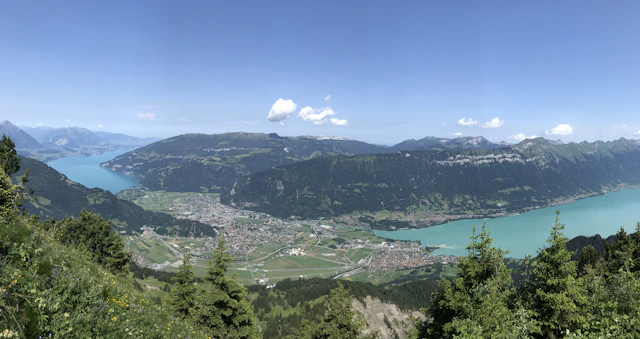
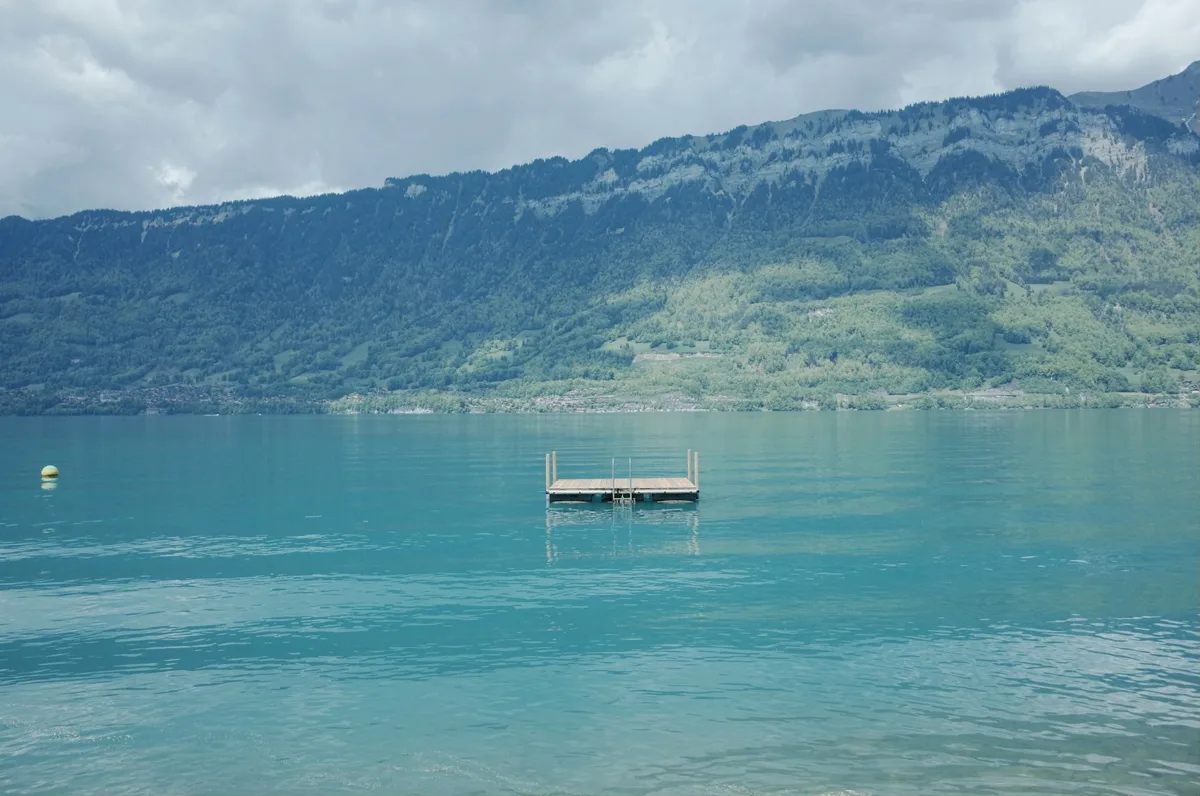
Interlaken sits between Lake Thun and Lake Brienz in the Bernese Oberland, at 568 m, and it is the junction almost every excursion in the Jungfrau Region runs through.
This guide is written the other way round from most: the fares come from the operators' own pages, the travel times from the Swiss timetable, both carrying the date they were checked — and where a trip does not justify what it costs, that is written down too.
destinations recorded and ranked
49
prices checked directly with the operators
17 September 2026 – 15 October 2026
the basis of every journey time on this page
Interlaken Ost
Start here
Where do you want to start?
You're deciding whether to come
An honest read on what Interlaken is good for, what it isn't, and who should base themselves in Grindelwald instead.
Worth answering plainly, because the honest answer is conditional. Interlaken is not a picture-book Alpine village — it is a resort town built around two railway stations, with a large protected meadow in the middle and a main street of watch shops and hostels. Nobody comes for the town.
What earns it a place on an itinerary is the junction. From Interlaken Ost you reach a two-lake viewpoint in seventeen minutes, the Lauterbrunnen valley in about twenty, an 1893 cogwheel railway in an hour and the highest railway station in Europe in an hour and a half — all without a car, and all from the same platform. No other town in the Bernese Oberland gives you that spread.
Stay somewhere else if you have three nights in the region and want to wake up under the Eiger: Grindelwald, Wengen or Mürren are better for that, and you will be at the cableways before the day-trippers. Stay in Interlaken if you are travelling by train, want to change destination each day, or are visiting both lakes.
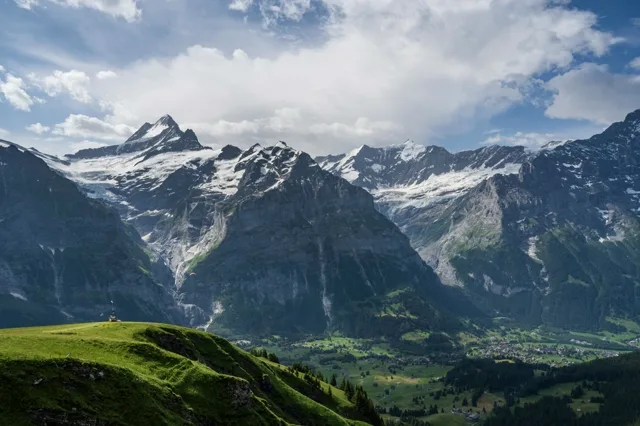
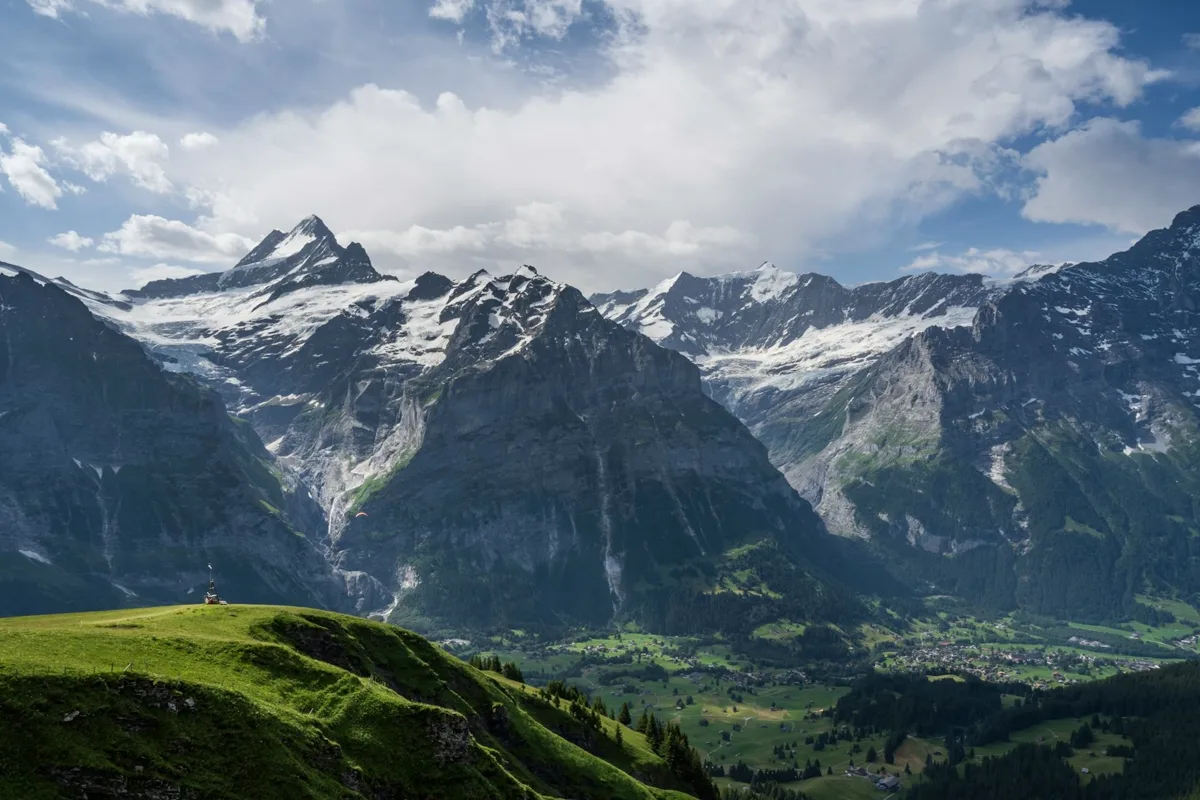
The Jungfrau Region in springEvelin Magnus / Pexels
Where Interlaken fits in a Switzerland trip
Most people arrive here as part of a longer route, and the practical question is not what to see but how many nights to give it. The rail geography answers most of it — the times below were measured against the official timetable over seven departures of the day on 21 August 2026:
From Zurich: 1 hr 55 min via Bern. Close enough that Interlaken is a plausible first stop straight off a long-haul flight.
From Geneva: about 3 hours via Bern, with a change — the natural second leg if you land in the west.
From Lucerne: 1 hr 50 min on the GoldenPass Panoramic, which is itself one of the better scenic rides in the country.
Onward to Zermatt: via Spiez and Visp; Interlaken sits neatly between Lucerne and the Matterhorn on a classic loop.
Against that: two nights is the point where the stop stops feeling rushed — one mountain, one lake, and an evening in town. One night buys you a single excursion and a train ride. Three nights is what a Jungfraujoch or Grindelwald First day needs if it is not going to eat the rest.
Insider Tip
If you have exactly one evening here, spend it on Harder Kulm at sunset. The funicular runs into the late evening in high summer, the coach groups are long gone, and it leaves from directly opposite Interlaken Ost — no connection to catch. Check the last descent before you go up; it moves through the season.
What it actually costs
The town is cheap and the mountains are not, and that surprises people more than hotel rates do. 11 of the 49 destinations on this site cost nothing at all. The range opens upwards:
Harder Kulm — from CHF 22, seventeen minutes from Interlaken Ost. The cheapest real mountain view in the region.
Schynige Platte — from CHF 34 for an 1893 cogwheel railway and the alpine garden at the top.
Niederhorn — from CHF 36, with a genuine chance of seeing ibex on the ridge.
Jungfraujoch — from CHF 129.60. That is the operator's lowest fare for a return ticket — the operator does not say from which station — and it consumes a full day.
St Beatus Caves — CHF 20, weatherproof and done in a little over two hours.
These are adult second-class fares without any reduction. A Swiss Travel Pass, the Half Fare Card, the GA travelcard and the local guest card each reduce them by a different amount — the full table carries all 49 destinations with fare, travel time, time needed and season. Each fare was read directly at the operator and carries its own check date, which stands beside it on the destination page: the registered fares were checked between 17 September 2026 and 15 October 2026, the Harder Kulm one, for instance, on 15 October 2026.
The excursions that earn their fare
These have a full page of their own — how to get there, what it costs, when it runs, and what to know before you buy the ticket. The rest are covered with travel time and fare on the main guide.
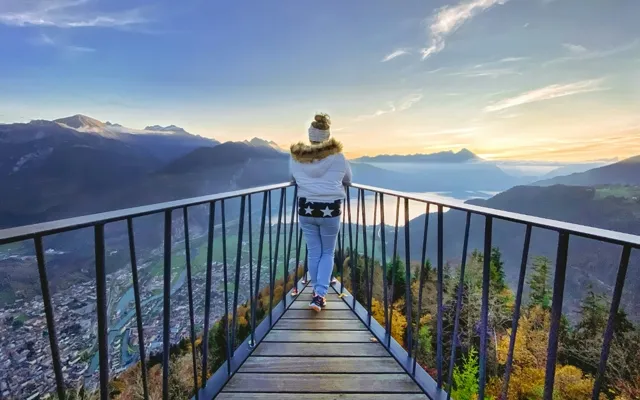
Interlaken's local mountain at 1,322 m, with the two-lakes viewing platform and a 360° view of Eiger, Mönch and Jungfrau. The funicular has its own valley station, seven minutes' walk from Interlaken Ost — if you would rather climb the 750 metres yourself, allow two and a half to three hours.
Skip the hike if you are short on time — the funicular takes ten minutes and the view is identical.
Viewpoint Getting there: 17 min · On foot + funicular
An alpine botanical garden at 1,967 m with around 800 plant species, reached by the 1893 cogwheel railway from Wilderswil. The panorama circuit takes around 2.5 hours and shows both lakes at once.
Closed outside 13 June to 25 October. Do not plan it for a spring or winter trip.
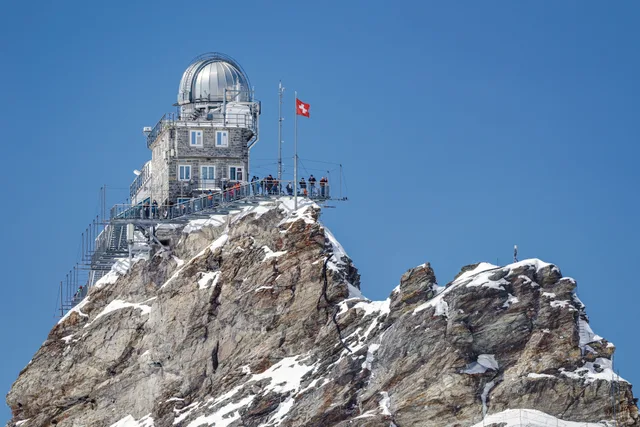
Europe's highest railway station at 3,454 m, with the Ice Palace, the Sphinx terrace and the Aletsch Glacier. The most expensive excursion in the region — and the only one that still works when it is raining in the valley.
The most expensive day in the region by a wide margin. Check the summit webcam before you buy — in cloud you pay a lot to see fog.
Those are places. What you book rather than travel to — a tandem
flight, canyoning, rafting, a boat — has a section of its own, with the season, the
time it takes and the one question a pass answers differently for each.
The published trail times for this region are unusually unreliable — estimates for the Harder Kulm ascent alone range from 1h30 to 3h50. The measured figures are 4.1 km, 750 m of ascent and two and a half to three hours on a marked mountain path graded T2.
Our hiking page lists six routes that actually work as day trips without a car, each with the travel time to the trailhead from Interlaken Ost, and explains the Swiss T-grading system, which is not obvious from outside the Alps.
June to September is the dependable window for both mountains and lakes. Spring and autumn are milder and far emptier, but part of the network shuts down — the Harder Kulm funicular runs April to November only, and the Schynige Platte railway a considerably shorter season than that — it does not open until mid-June. In winter, anyone who does not ski stays largely in the valley.
The sections of this site sort by the kind of place. Anyone planning a day, though, usually starts from a circumstance — rain, children, January. These four entry points run across the categories, and their counts come from the same data as the comparison tables.
On any given day the cloud base matters more than the month: below a low overcast, a mountain railway ticket is money thrown away. The weather page carries the outlook for the coming days.
How we check
Every price and every journey time on this page comes from the operator’s own website or from the timetable — with the date, readable at each destination.
Destinations recorded
49
Prices checked
17 September 2026 – 15 October 2026
Journey times
from Interlaken Ost
Advertising
no paid placements
Frequently Asked Questions
Is Interlaken worth visiting?
Yes, but not for the town itself. Interlaken is a transport hub with a famous meadow and a lot of souvenir shops; what makes it worth a stop is that almost every excursion in the Jungfrau Region starts from its eastern station. If you want an Alpine village to sit in, Grindelwald or Wengen will serve you better. If you want a base to travel out from, this is the one.
How many nights should I spend in Interlaken?
Two is the useful minimum: one mountain, one lake, and the town. One night works only if you accept doing a single excursion. Three nights is where Jungfraujoch or Grindelwald First fits in without cutting everything else short — the day-by-day breakdown is on the things-to-do guide.
What's the difference between Interlaken Ost and Interlaken West?
Interlaken Ost is where the excursions start: the Harder Kulm funicular, the trains to Lauterbrunnen and Grindelwald, the Schynige Platte cogwheel railway and the Lake Brienz boats. Interlaken West is closer to the shops and to the Lake Thun boats. They are about a 20-minute walk apart, or four minutes by train.
Is Jungfraujoch worth the money?
The entry fare is from CHF 129.60 and it takes a full day. It is worth it if standing on a glacier at 3,454 m is something you specifically came to Switzerland for. If what you want is a view of Eiger, Mönch and Jungfrau, Harder Kulm gives you that from CHF 22 in an evening.
Do I need a car in Interlaken?
No — 48 of the 49 destinations on this site are reachable from Interlaken Ost by train, bus, boat or cableway, and the travel time is listed for each. A car is close to useless here: the mountain railways leave from valley stations anyway, and the car then sits in a paid car park all day.
What can you do in Interlaken when it rains?
The St Beatus Caves are the same temperature whatever the weather, and the lake boats run regardless. Skip the mountain railways on a low-cloud day — the view is the entire point, and the valley stations show the summit webcam before you buy a ticket.
Is the Swiss Travel Pass worth it for Interlaken?
It covers the trains and boats fully and gives a discount rather than free travel on most mountain railways. Whether it pays off depends on the rest of your itinerary, not on Interlaken alone — what it covers here in detail is on the things-to-do guide.
 from CHF 22