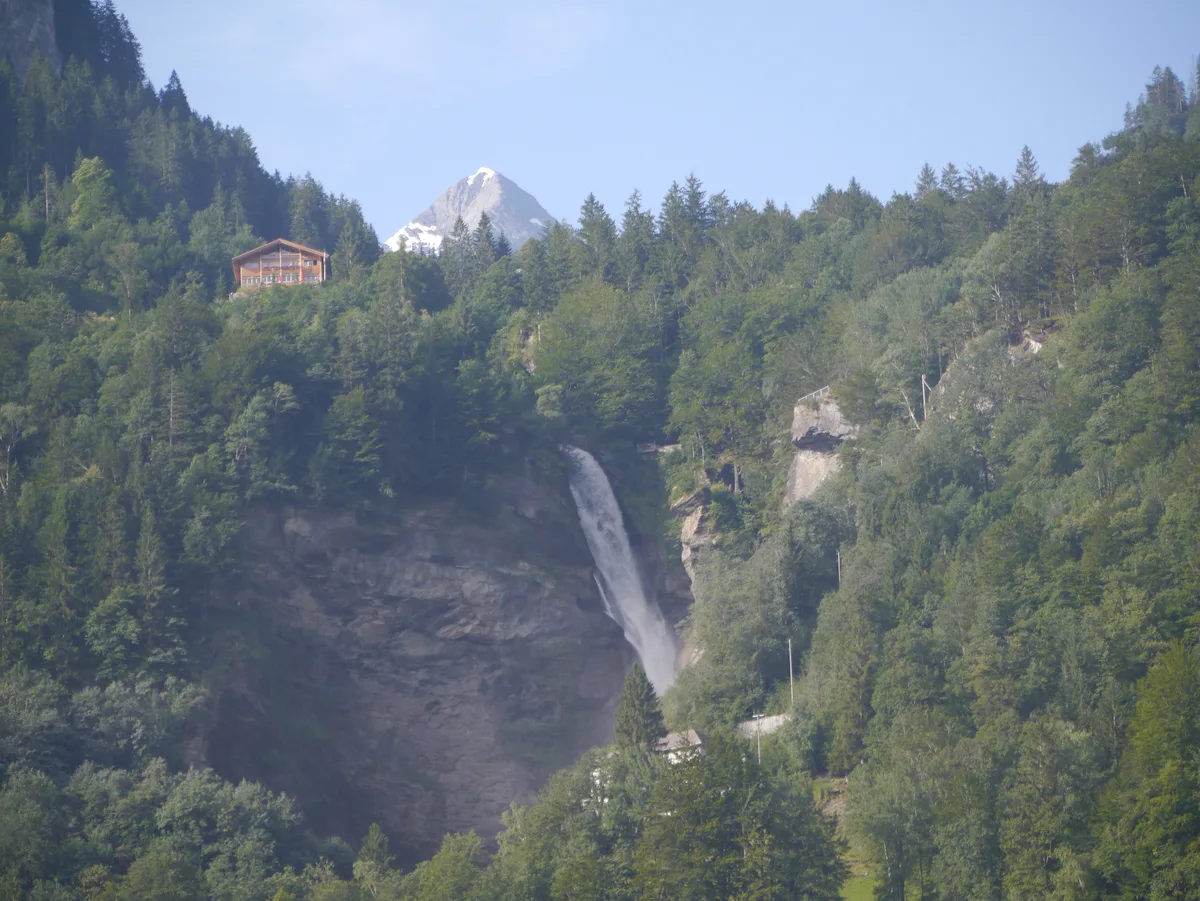
In short
The Reichenbach Falls drop in several stages into the basin above Meiringen, and a funicular built in 1899 runs to the brink from May to October. That is not why most people come. In 1893 Arthur Conan Doyle sent Sherlock Holmes over these falls, and ever since a large share of visitors have been looking for a location rather than a waterfall. This page keeps the two apart — the practical journey first, the story afterwards.
Quick Facts
- Getting There
- 63 min from Interlaken Ost, two changes Journey time checked
- Duration
- Half day
- Price
- CHF 10.00 Checked with the operator
- Season
- 1 May – 3 October 2027 (funicular)
- Best for
- Views, families, literary pilgrimage
Chapter 01
Getting there: 63 minutes and two changes
63 minutes from Interlaken Ost to the top station at the falls, two changes, measured on the Swiss timetable for a summer weekday across four departure times. The longest leg is the simplest one: the train to Meiringen takes 31 minutes and runs direct; after that come the local bus to Willigen and the funicular.
If you are coming from Zurich rather than staying in Interlaken, treat this as an add-on and not a day trip in itself. Meiringen sits on the line towards the Brünig pass and Lucerne, which means the falls fit naturally into a transfer day between Lucerne and the Bernese Oberland — a routing that costs you almost nothing extra and that the operator's own pages never mention, because they are not in the business of planning your week.
One detail worth reading twice: the 63 minutes end at the top of the falls, not at the valley station. The funicular has two timetable stops of its own — "Willigen (Reichenbachfallbahn)" at the bottom and "Reichenbachfall" at the top — and both are inside the figure: Willigen is 45 minutes out, the ride up takes 7 minutes and leaves every quarter of an hour. The rest of the difference is the wait for it.
Chapter 02
What the funicular costs
Adults pay CHF 10.00 one way and CHF 15.00 return; children aged 6 to 15 pay CHF 7.00 one way. All fares checked on 15 October 2026 on the operator's own page. The railway is run as a commitment of KWO, Kraftwerke Oberhasli AG, the regional power company — which is a fair part of why the fares are low by the standards of mountain railways in this region.
Chapter 03
Two sources, two sets of figures — and which one to use
This is worth a close look, because the two sources a visitor finds first disagree. The Berner Oberland Pass page states the benefit as «Erwachsene (Vollzahler und Ermässigte) bezahlen den Kinder-Preis» — adults pay the child fare — and puts the saving at two francs on a single and four on a return. Those figures assume fares the operator no longer charges: the pass page is still working from an older tariff, while the operator's own page on the same day shows CHF 10.00 and CHF 15.00.
We do not resolve the contradiction; we say which half holds. Use the pass page's rule, not its numbers. With a Berner Oberland Pass you pay the child fare — CHF 7.00 one way at the current tariff, not the six francs printed there. On the Swiss Travel Pass neither source says anything at all, which is why we write "Not verified" rather than a guess.
Chapter 04
The season is shorter than most people assume
The 2026 season ended on 4 October; for 2027 the operator gives 1 May to 3 October, daily from 9.00 to 17.30, last ascent 17.15 (checked 15 October 2026). That is markedly shorter than the railways visitors calibrate against elsewhere in the region, and it is the most common avoidable mistake here: arrive in April or late autumn and you will find the valley station shut. The falls themselves still run — you just lose the easy view from the top.
Chapter 05
Is it worth it?
Probably yes if you were already giving the Haslital a half day. The falls alone will not fill one: the ride is short and the stop at the top is brief. What makes the trip work is the neighbourhood — the Aare Gorge is minutes away and works in the rain, and the Rosenlaui glacier gorge is an hour further out and quieter. Both appear with journey times and fares in our round-up of destinations further out.
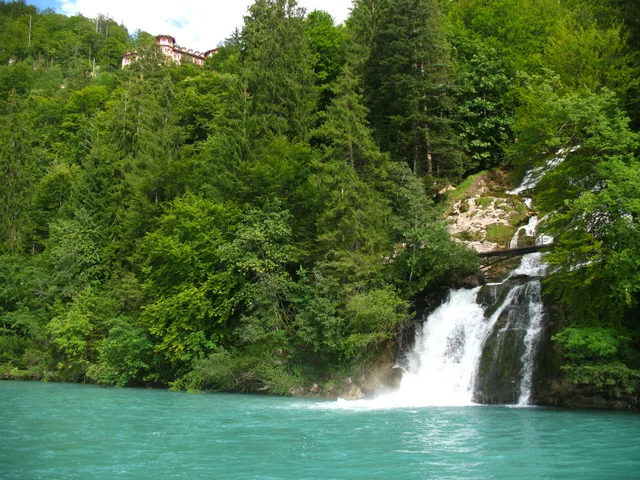
Probably not if you want a big waterfall and the story means nothing to you. In that case the Giessbach Falls on Lake Brienz are the better call: closer to Interlaken, open year-round, and falling in fourteen stages straight into the lake. A good deal of what makes the Reichenbach Falls worth the trip is knowing what is supposed to have happened here.
Chapter 06
The Holmes connection, honestly
Doyle published «The Final Problem» in 1893, in which Holmes and Professor Moriarty grapple at the edge and go over together. He wanted the character gone; his readers disagreed so forcefully that Holmes was eventually brought back. Meiringen has maintained the association ever since, and the search data bears out how well it has travelled: British interest in these falls runs to many times the American figure, which is true of no other destination on this site.
The honest expectation to set: what is actually here is a waterfall, a funicular and a plaque. It is a real place used for a fictional death, not a reconstruction. Come expecting an attraction built around the story and you will be disappointed; come to stand where one of the best-known scenes in popular literature is set, and that is exactly what you get.
Timetable and fares for the Reichenbachfall funicular from the operator
Chapter 07
Where it is
The falls lie in the municipality of Schattenhalb, immediately above Meiringen. Coordinates and elevation come from the Swiss federal gazetteer and height service (queried 8 August 2026, listed there as "Fliessgewässer Reichenbachfall"); the measured point sits at 784 m, while the funicular's line begins around 600 m in the valley. The Aare Gorge and the Rosenlaui Glacier Gorge are in the same valley — both appear in the table and on the map of the hub, without pages of their own.
Frequently Asked Questions
How do I get to the Reichenbach Falls?
Train from Interlaken Ost to Meiringen, then the local bus to Willigen for the funicular's valley station, then the funicular itself. 63 minutes to the top station at the falls, two changes, measured on the Swiss timetable for a summer weekday across four departure times. The train leg alone is 31 minutes and runs direct; the valley station is 45 minutes out, and the funicular takes 7 minutes on top of that.
How much does the Reichenbach funicular cost?
Adults pay CHF 10.00 one way and CHF 15.00 return; children aged 6 to 15 pay CHF 7.00 one way. Fares checked on 15 October 2026 on the operator's own page. With a Berner Oberland Pass the pass's own page states the rule «Erwachsene (Vollzahler und Ermässigte) bezahlen den Kinder-Preis» — adults pay the child fare.
When is the Reichenbach funicular open?
The 2026 season ended on 4 October. For 2027 the operator gives 1 May to 3 October, daily from 9.00 to 17.30, with the last ascent at 17.15 (checked 15 October 2026). Outside that window the funicular does not run. The waterfall is still there and still visible — you simply cannot ride to the viewpoint at the brink.
Is this really where Sherlock Holmes died?
It is the real place Conan Doyle used for a fictional event. He published «The Final Problem» in 1893, in which Holmes and Moriarty go over these falls together, because he wanted to be rid of the character; readers objected and Holmes came back. Meiringen has kept the association ever since. What you find on site is a waterfall, a funicular and a plaque — not a staged set.
Is it covered by the Swiss Travel Pass?
We could not source an answer, so we do not print one. Neither the operator nor the Berner Oberland Pass page mentions the Swiss Travel Pass for this funicular. Rather than reason from what usually applies to short Swiss mountain railways, we write "Not verified" rather than a guess — check with the operator before you count on it.
Related Articles
Sources & last check
- Price
- grimselwelt.ch · checked
- Winter access
- grimselwelt.ch · checked
- Coordinates
- swisstopo · checked