In short
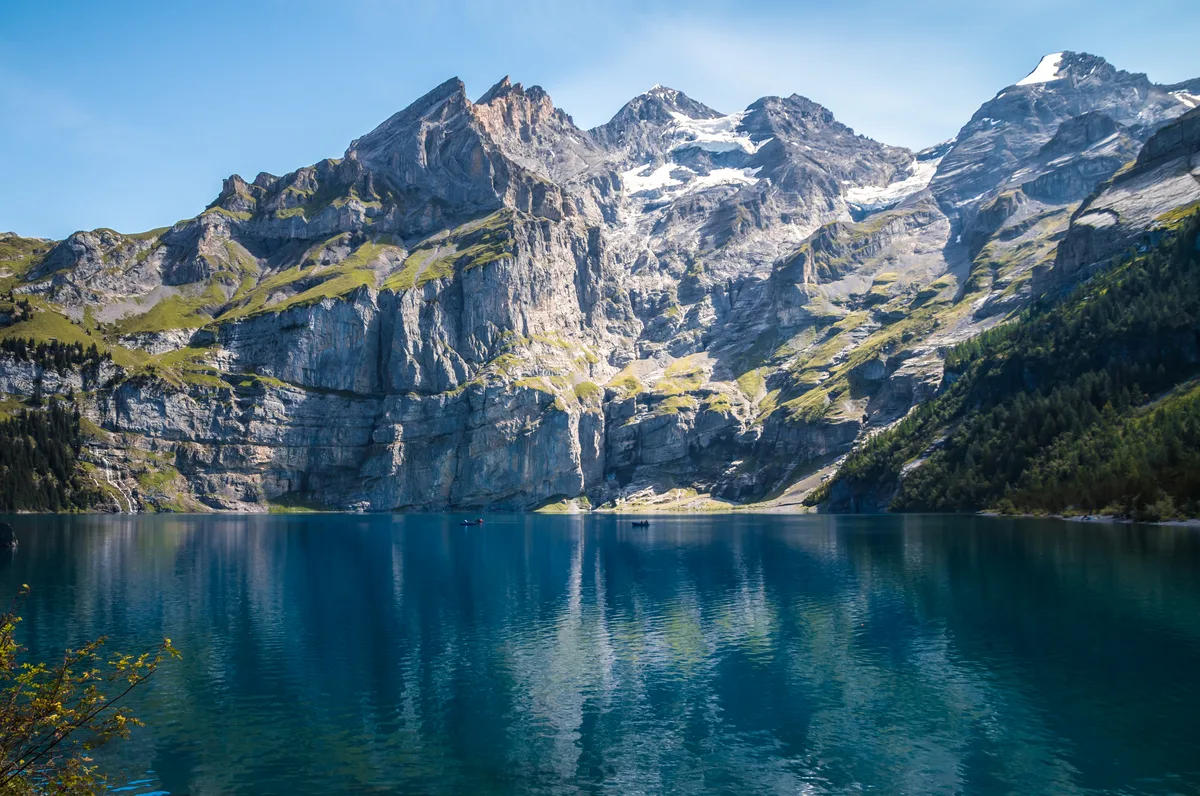
Oeschinensee is searched from Switzerland more than any other destination in this guide, and one of the furthest that still work as a day trip. The photographs show turquoise water below the Blüemlisalp; what they leave out is the chain to get there — three changes, a gondola, and then half an hour on foot. The operator publishes fares, timetable and access rules in three separate blocks of one page, and the journey from Interlaken nowhere at all. This page puts them side by side.
Quick Facts
- Elevation
- 1,575 m
- Getting There
- 123 min from Interlaken Ost, 3 changes Journey time checked
- Duration
- Full day
- Price
- CHF 36.00 Checked with the operator
- Season
- May to November, winter service from December
- Best for
- Hiking, swimming, rowing
Chapter 01
What your rail pass actually does here
It reduces the fare. It does not cover it. This is the single most useful thing to know before you set out with a Swiss Travel Pass, and it is the same pattern as the Jungfraujoch: the pass buys a discount on the gondola, not a ride on it. A Swiss Travel Pass, a Half Fare card and a GA all land on the same reduced figure — there is no ranking between them here.
The Berner Oberland Pass is not accepted at all. The operator says so in as many words, and it is the kind of detail you would otherwise discover at the barrier.
| 9 May – 14 Jun | 15 Jun – 21 Sep | 22 Sep – 9 Nov | |
|---|---|---|---|
| Adult | CHF 36.00 | CHF 40.00 | CHF 36.00 |
| Half Fare, GA, Swiss Travel Pass | CHF 18.50 | CHF 22.50 | CHF 18.50 |
| Child | CHF 18.50 | CHF 22.50 | CHF 18.50 |
| Descent only, adult | CHF 26.20 | CHF 26.20 | CHF 26.20 |
| Descent only, Half Fare, GA, Swiss Travel Pass, child | CHF 13.10 | CHF 13.10 | CHF 13.10 |
The most useful lines are the bottom two. Descent-only costs CHF 26.20 all summer season, CHF 13.10 with a Swiss Travel Pass, Half Fare card or GA, and is the one fare that is not staged by season. Walk up and ride down in high season and you pay CHF 26.20 instead of CHF 40.00, or CHF 13.10 instead of CHF 22.50 with a pass — set against the roughly 90-minute climb, that is not much of a saving. Going up on foot is a question of appetite, not of money. Dogs are not free either: a day ticket costs CHF 8.00.
The winter fares are last winter's. The operator publishes exactly one winter tariff block, headed «Winter 2025/26» with the date column 22.11.2025–08.03.2026: CHF 32.00 return, CHF 24.00 one-way, checked on 14 October 2026. For the winter operation from 5 December 2026 to 7 March 2027 — which the same timetable announces further down — there is no fare there yet. So the two figures are the last sourced state, not a promise for the coming season. The one-way is sold in winter only to people on snowshoes, and the reason sits in the operator's own column heading: there is no winter walking route back down.
One figure is missing here on purpose. The ascent-only fare sits in a block that still carried 2025 date columns on 14 October 2026, while the blocks beside it read 2026. A number from a stale block is not a sourced number, even when it sits on the right page.
Chapter 02
The journey, in two parts
123 minutes from Interlaken Ost to the shore. That splits into 93 minutes to the gondola's top station — train to Spiez, train to Kandersteg, local bus to the valley station, gondola up — plus the 30 minutes on foot the operator allows to the water. Measured on the Swiss timetable for a summer Wednesday, as the fastest connection across eight departure times.
Two sources give two walking times, and we publish the longer. The timetable allows 23 minutes between the top station and the lake; the operator says 30. Both are defensible, and we take the operator's because it is the more cautious of the two. The path is pushchair-friendly. In summer an electric taxi runs from the top station to the lakeside restaurant every half hour; it costs money, but the operator publishes no fare for it, so none is quoted here. Guests with reduced mobility have priority on it.
Chapter 03
No car, no bike, no exceptions
The access road is closed to all motorised traffic and to bicycles, mountain bikes and e-bikes. The gondola carries no bikes, children's bikes, kick scooters or SUPs. That is a prohibition rather than a suggestion, and it leaves exactly two options: the gondola plus the walk, or about 90 minutes on foot from Kandersteg.
Until 8 November 2026 inclusive the ascent is subject to compulsory reservation — the operator sets that window over the whole summer season to the end of autumn service, not just the high season, and it is more than the time slot that a ticket from the operator shop carries anyway (free to rebook). In that window every guest needs a separate time-slot reservation in addition to a valid ticket, explicitly including tickets bought in the SBB Mobile app or from a reseller. Once the slots are gone, no ascent is possible even with a paid, valid ticket. Read on the operator tariff page on 14 October 2026.
If you drive as far as Kandersteg: a parking ticket can only be booked together with a gondola ticket, spaces are limited, and parking cannot be reserved on its own.
Chapter 04
Open, closed, and the two-month gap
- Summer daily 9 May – 20 Sep 2026, 08:30–18:00
- Autumn daily 21 Sep – 8 Nov 2026, 08:30–17:00
- Weekends only 14 Nov – 29 Nov 2026, 08:30–17:00
- Winter daily 5 Dec 2026 – 7 Mar 2027, 09:00–17:00
Between 7 March and 9 May the gondola does not run at all — roughly two months, and precisely the snowmelt weeks the lake is most photographed in. Two shorter gaps sit either side of the November weekends: 9–13 November and 30 November to 4 December.
Chapter 05
Worth a whole day, or not at all
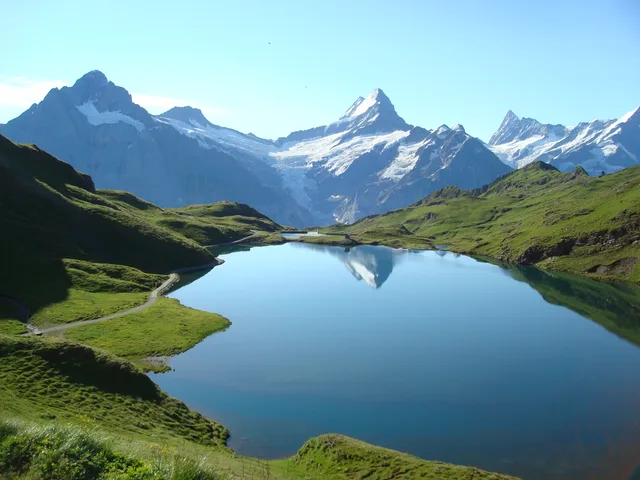
Two hours each way means a whole day, not a stop between two other things. Leave Interlaken in the morning, reach the water around midday, return in the evening — nothing else fits around it. That is why this lake sits under "further out" in this guide rather than beside the Bachalpsee, which is inside the Jungfrau Region and delivers a comparable postcard. Not because the Bachalpsee is nearer — it is 132 minutes from Interlaken Ost against 123 here — but because it gives the day back: a half day against a full day.
Every day trip outside the Jungfrau Region, with travel time and fare
Frequently Asked Questions
Does the Swiss Travel Pass cover the Oeschinensee gondola?
No — it reduces the fare, it does not cover it. With a Swiss Travel Pass, a Half Fare card or a GA you pay CHF 22.50 return in high season and CHF 18.50 either side of it, against CHF 40.00 and CHF 36.00 full fare. The Berner Oberland Pass is not accepted at all, which the operator states explicitly. All figures checked at the operator on 14 October 2026.
How long does it take to reach Oeschinensee from Interlaken?
123 minutes to the shore, and the figure has two parts: 93 minutes by train, local bus and gondola to the top station — measured on the Swiss timetable as the day's fastest across eight departures on a summer Wednesday — plus the 30 minutes on foot the operator allows from the top station to the water. The timetable itself allows only 23 minutes for that stretch; we publish the operator's more generous figure. Three changes: Spiez, Kandersteg, and the valley station.
Can you drive or cycle to Oeschinensee?
Neither. The access road is closed to all motorised traffic and, explicitly, to bicycles, mountain bikes and e-bikes as well. The gondola carries no bikes, kick scooters or SUPs either. That leaves two ways to the water: the gondola plus a 30-minute walk, or roughly 90 minutes on foot up from Kandersteg.
Do you need to book in advance?
Until 8 November 2026 inclusive, yes, and it is binding: the ascent is subject to compulsory reservation in that window — the operator sets it over the whole summer season to the end of autumn service, not just the high season. Every guest needs a separate time-slot reservation in addition to a valid ticket — explicitly including tickets bought in the SBB Mobile app or from a reseller. Once the slots are gone, no ascent is possible even with a paid, valid ticket. A ticket from the operator shop carries its slot, free to rebook. If you arrive by car there is a further condition worth knowing: a parking ticket can only be booked together with a gondola ticket, the number of reservable spaces is limited, and parking cannot be reserved on its own.
Is the gondola open in spring?
No, and this is the gap that catches people out. Summer service runs daily from 9 May to 20 September, autumn service to 8 November, then three weekends in November, and winter service from 5 December to 7 March. Between early March and early May the gondola stands still for about two months — which is exactly the snowmelt season the lake is most photographed in. The alternative is the 90-minute walk up from Kandersteg.
Related Articles
Sources & last check
- Price
- oeschinensee.ch · checked
- Winter access
- oeschinensee.ch · checked
- Coordinates
- swisstopo · checked